
Berdua di Sepeda Cinta a short love letter to a painting
Berdua di Sepeda Cinta a short love letter to a painting
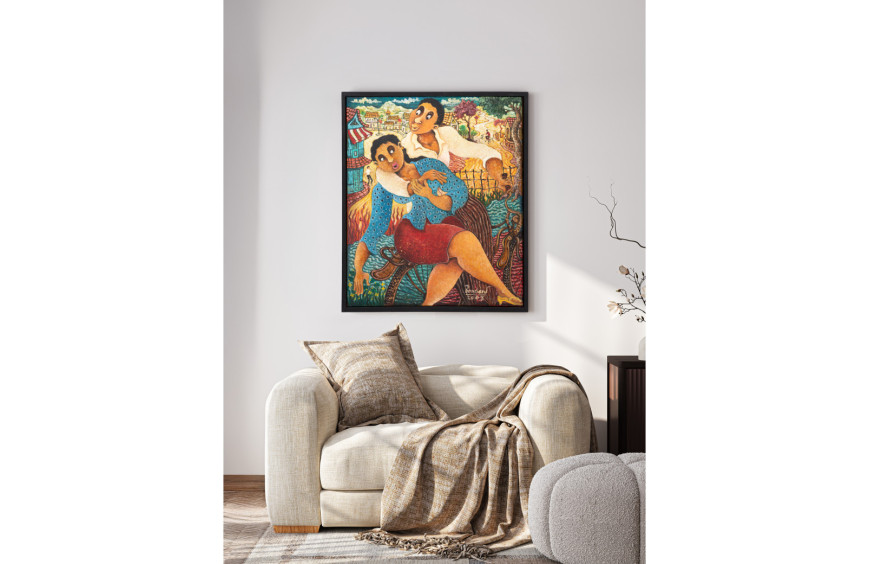
Berdua di Sepeda Cinta is a quiet, tender meditation on love as shared movement. Using the bicycle—a timeless symbol of balance, freedom, and progress—the painting frames intimacy not as possession, but as direction: two people moving forward together, negotiating space, rhythm, and trust. Subtle gestures, warm mid-tones, and repeating circular motifs turn an everyday scene into a poetic metaphor for resilience and care. Rooted in contemporary Indonesian visual storytelling, the work elevates the ordinary into something quietly radical—suggesting that love, like cycling, survives through balance, cooperation, and the courage to keep moving.
The bicycle in art is a versatile symbol. It evokes movement and freedom, but also cycles, repetition, and the fragile balance that keeps two wheels — and two people — upright. Historically, artists have used the bicycle to speak about modernity, social change, and the rites of passage of ordinary life. In this painting, the bicycle becomes a metaphor for shared direction: love as forward momentum rather than static possession. Contemporary writers on art and cycling note that bicycles often stand for progress, resilience, and intimate mobility — the private publicness of travel together. usa.streetsblog.org+1
Composition as conversation
Berdua di Sepeda Cinta speaks in a shorthand of gesture. The figures’ posture and the negative space around them do most of the talking: a shoulder leaning toward a shoulder; a hand steadying the handlebars while the other hand reaches back; a gaze not so much fixed forward as attuned to the companion’s face. That relational geometry — bodies arranged to make room for each other — is a small formal revolution. The artist trades dramatic brushwork for tender choreography: every mark is a reason for the eye to return to the interpersonal center.
Color and mood
Warm mid-tones dominate: the ochre of late afternoon light, the soft magenta of skin touched by sunset. Spots of saturated color — a red scarf, blue rim on the bicycle wheel — act like punctuation marks, adding emotional emphasis and rhythmic movement across the pictorial plane. The wheel, a visual metronome, repeats circular motifs elsewhere (bows of clothing, round lanterns), reinforcing the idea of recurring life cycles and shared habits. The symbolism of the wheel as cycle/time and of the bicycle as freedom appear repeatedly in cultural commentary, making this choice both poetic and culturally legible. Wikipedia+1
Cultural resonance — an Indonesian context
If we read this painting through the lens of modern Indonesian figurative and contemporary art (several Indonesian names appear in the artist list you shared), the work resonates with practices that fuse local motifs and modern narrative. Indonesian painters in the roster — artists such as Yayat Surya and Krijono — are noted for integrating pop culture, folklore, and vibrant color into figurative scenes that often carry social or emotional narratives. The book-like storytelling, the use of saturated palettes, and an attention to public/private life fit squarely within that tradition.
Yayat Surya’s work, for example, often places cultural icons and narrative figures into charged compositions that interrogate identity and public feeling. The tendency to treat pop life as serious cultural text helps make a domestic scene like Berdua di Sepeda Cinta feel both intimate and socially legible.
Krijono’s energetic, folkloric colors and incorporation of traditional motifs offer a helpful precedent for reading the painting’s color choreography and symbolic dress.
The everyday as political — quiet radicalism
A bicycle shared is a small, everyday redistribution of space: two people using one machine, negotiating balance and direction. In many modern and post-colonial visual cultures, this tidiness doubles as low-level political action: sharing, mutual care, mobility without consumption. Recent essays on art and cycling note how the bicycle signifies utopian possibilities — a slower, more equitable social order — and becomes a visual shorthand for movement toward something better. Viewed in this light, Berdua di Sepeda Cinta becomes a humble utopia: a private world that embodies a public ethic of care and mobility. The MIT Press Reader+1
Formal notes for readers who like details
Medium & brushwork: imagine warm layers of oil or acrylic with visible brush rhythms that suggest motion rather than freeze action. The wheel’s spokes may be rendered with quick linear strokes to communicate rotation.
Scale & intimacy: the canvas likely feels close — not a monumental tableau, but a domestic window into a moment. This scale invites quiet contemplation.
Iconography: small props (a woven basket, a dangling ribbon, a market stall in the blur) anchor the figures in social life — places where love is practiced, not only professed.
Why this painting matters
There is a reason small, tender works about everyday acts endure: they make public the private gestures that actually sustain communities. Berdua di Sepeda Cinta asks little of the viewer’s ideology and everything of their empathy. It’s a painting that rewards long looking: the more you stay, the more the small formal choices — the tilt of the handlebars, the particular mix of light and pigment — translate into cumulative emotional force.
Suggested reading & sources
On the bicycle as an art symbol and cultural object: “The Bicycle in Art: A Universal Symbol of Progress” (Streetsblog). usa.streetsblog.org
Design and cultural commentary on bicycle symbolism (Copenhagenize / design essays). Сopenhagenize
Short contemporary pieces on how bicycles appear in modern artworks and their utopian resonances (Mojarto blog; MIT Press reader). blog.mojarto.com+1
On the wheel as a symbol for cycle/time and cultural meanings: Wikipedia entry "Wheel" (useful for background on symbolic layers). Wikipedia